
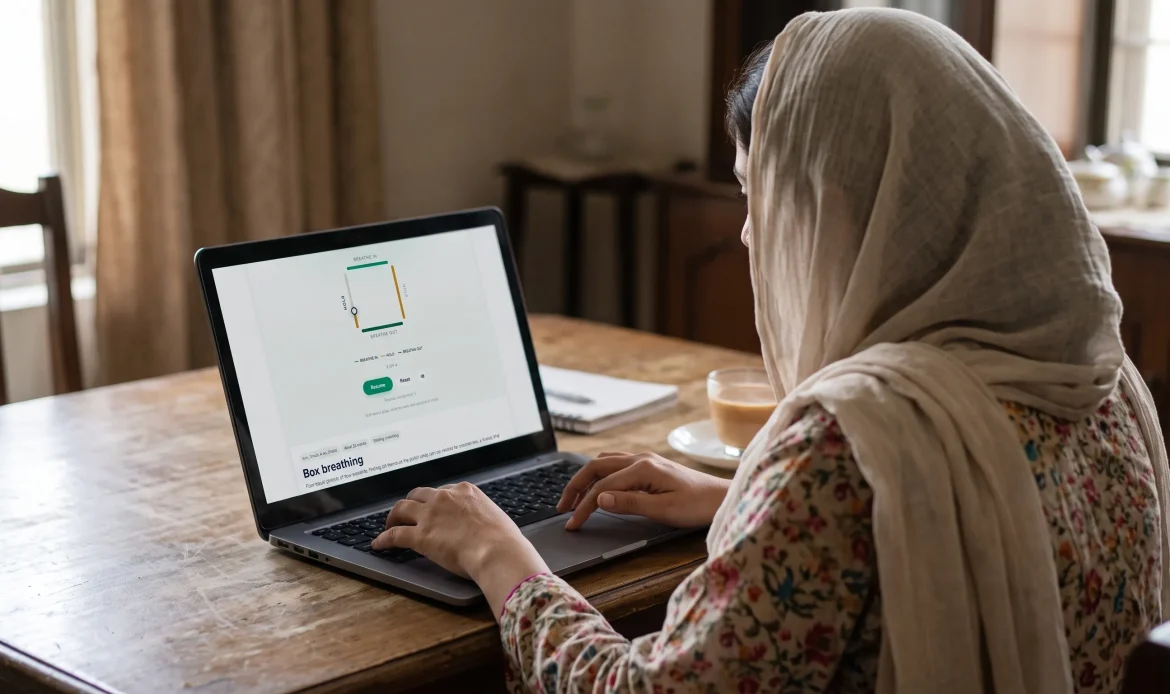
Breathing Exercises and Grounding Techniques to Calm Down
Three exercises you can follow on screen instead of counting in your head: box breathing, paced inhale and exhale, and 5-4-3-2-1 grounding. Use them for stress, anxiety, anger, panic, overthinking, or a night when your mind will not switch off. Press start on any card and follow the video. Nothing is recorded and nothing is sent anywhere.
What are these exercises, and what do they help with?
Box breathing, paced inhale and exhale, and 5-4-3-2-1 grounding are three short exercises that help you calm down. Use them for stress, anxiety, anger, panic, overthinking or trouble sleeping. Each one runs on screen, so you follow the pace rather than counting alone. They take two to five minutes.
- Rated 4.7 by 500+ patients on Google
- Licensed by the Punjab Healthcare Commission, licence R-05172
- Free, private, nothing saved
People use these for
- Stress
- Anxiety
- Panic attacks
- Anger
- Overthinking
- Exam pressure
- Work pressure
- Feeling overwhelmed
- Winding down at night
- Before a difficult conversation
Ready when you are
- Breathe in
- Hold
- Breathe out
4 seconds each side
Rounds completed: 0
Soft sound plays while it runs. Use the speaker to mute.
Box breathing
Four equal phases of four seconds. The equal counts are the point: when you are too anxious to concentrate, a shape that repeats the same way every time is easier to follow than a rhythm you have to remember. Each side of the square is a different phase and a different colour, so you always know whether you are breathing or holding. Follow the marker with your eyes and let your breath match it.
- Breathe in for four. Sit with your back supported and your feet on the floor. Breathe in gently through your nose as the marker travels along the top side.
- Hold for four. Hold gently as the marker comes down the right side. Do not clamp down or strain.
- Breathe out for four. Let the breath flow out through your mouth as the marker travels back along the bottom.
- Hold for four, then repeat. Hold up the left side with the lungs empty, then begin again. Eight rounds is about two minutes.
Ready when you are
Breaths completed: 0
Soft sound plays while it runs. Use the speaker to mute.
Paced inhale and exhale
This is the calming breathing technique the NHS describes, with no hold in it at all. Breathe in gently and regularly, counting steadily from one to five, then let it flow out gently for a count of five. The circle grows as you breathe in and shrinks as you breathe out, so you never have to count for yourself [1].
- Get comfortable. Sit in a chair that supports your back, or lie down. Let your shoulders drop. You can also do this standing.
- Breathe in for five. Gently and regularly through your nose while the circle expands. Do not gulp the air.
- Let it flow out for five. Let the breath leave on its own while the circle shrinks. Do not force it and do not pause between.
- Keep going for five minutes. Doing this daily when you are calm works better than only reaching for it in a crisis.
Ready when you are
5-4-3-2-1
Five senses, counting down. Name each thing in your head or out loud.
Step 0 of 5
Soft sound plays while it runs. Use the speaker to mute.
5-4-3-2-1 grounding
Grounding moves your attention out of your thoughts and back into the room you are actually in [2]. It is the one to reach for when the problem is spiralling thoughts, or a feeling of being unreal or detached, rather than a racing heart. Clinical guidance describes grounding as a way to help someone who is overwhelmed by memories or strong emotions become aware of the here and now [3].
- Five things you can see. Ordinary things count: a door handle, a fan, a crack in the paint.
- Four things you can feel. The chair against your back, your feet inside your shoes, the temperature of the air.
- Three things you can hear. Listen for the quietest sound you can find, not the loudest.
- Two things you can smell. If you cannot smell anything, name two smells you like.
- One thing you can taste. Or take a sip of water and notice it. Then check how you feel, and repeat if you need to.
When these are not the right tool
These are coping tools that bring distress down in the moment. They can steady you during stress, anger, panic, overthinking or a restless night, but they do not treat an anxiety disorder, depression, panic disorder or trauma, and they are not a substitute for an assessment. Skip the breath holding in box breathing if you are pregnant, have a heart or lung condition, or find that holding makes you more anxious, and use the paced inhale and exhale exercise instead. If you or someone close to you is in immediate danger or at risk of self harm, contact emergency services now: Rescue and Ambulance 1122, Police 15, Edhi 115, Chhipa 1020, or your nearest government hospital emergency department. SehatYab is an online clinic and is not an emergency service.
Breathing and grounding, frequently asked questions
Short answers to what people ask us most about these exercises.
If you are reaching for these every day, that is worth a conversation
Coping tools hold the moment. Therapy changes the pattern, whether that is anxiety, low mood, anger, burnout or sleep that never settles. Book a private online session with a clinical psychologist, in Urdu or English, from anywhere in Pakistan.
Innovista Rawal, DHA Phase 1, Rawalpindi, Pakistan.
Phone: +92 304 111 2310. Online consultations only, no walk in clinic.
Licensed and regulated by Punjab Healthcare Commission (PHC), licence R-05172. Serving Pakistan since 2016.